Our chapter takes its name from the pioneer settlement of Hickory Bluff in what is now Port Charlotte, Florida.
The name Hickory Bluff was given to the area due to a bluff overlooking Charlotte Harbor, which was covered with hickory trees. Sadly, the hickory trees were all timbered off by an axe handle factory after the Civil War. The Hickory Bluff Indian mound was leveled in 1926 for a housing development.
Today Chester Roberts Park is located in the original pioneer settlement of Hickory Bluff; the area is now called the Charlotte Harbor Town Local Historic District. The entire area gradually became known as Charlotte Harbor after the post office with that name was established in 1872.
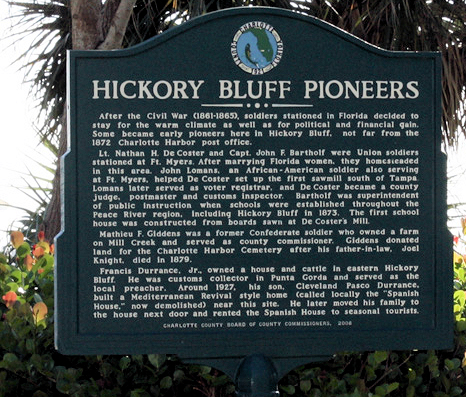
Photo courtesy of Hickory Bluff Chapter, NSDAR members.
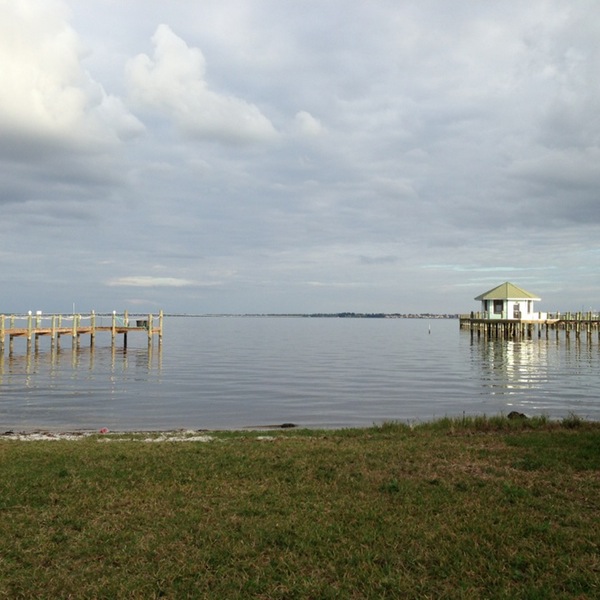
Photo courtesy of Hickory Bluff Chapter, NSDAR members.
The text on the marker reads:
After the Civil War (1861-1865), soldiers stationed in Florida decided to stay for the warm climate as well as for political and financial gain. Some became early pioneers here in Hickory Bluff, not far from the 1872 Charlotte Harbor post office.
Lt. Nathan H. DeCoster and Capt. John F. Bartholf were Union soldiers stationed at Ft. Myers. After marrying Florida women, they homesteaded in this area. John Lomans, an African-American soldier also serving at Ft. Myers, helped DeCoster set up the first sawmill south of Tampa. Lomans later served as volunteer registrar and DeCoster become a county judge, postmaster and customs inspector. Barthoff was superintendent of public instruction when schools were established throughout the Peace River region, including Hickory Bluff in 1973. The first school house was constructed with boards sawn at DeCoster’s mill.
Mathieu F. Giddens was a former Confederate soldier who owned a farm on Mill Creek and served as county commissioner. Giddens donated land for the Charlotte Harbor Cemetery after his father-in-law, Joel Knight, died in 1979.
Francis Durrance, Jr., owned a house and cattle in eastern Hickory Bluff. He was customs collector in Punta Gorda and served as the local preacher. Around 1927, his son, Cleveland Pasco Durrance, built a Mediterranean Revival style house (called locally the “Spanish House”, now demolished) near this site. He later moved his family to the house next door and rented the Spanish House to seasonal tourists.